

What Is Democracy?

Based on the original article I published in 2022 and in light of the subsequent shift away from "representative democracy," we need to be clear about what democracy really is. Otherwise, how can we know what we want or what we are willing to defend?
Let's start by discussing what democracy is not. Most people think democracy has something to do with electing leaders, or "representatives." This is called "representative democracy" (RD), and it is practically the polar opposite of "democracy."
As a concept, RD immediately falls flat on its illogical face. The whole point of RD is to select representatives to form or perpetuate the government that will forever rule your life. The reason given for the RD system is that we are all incapable of ruling ourselves.
Thus, all RD governments and all citizens who vote politicians into office assume that no one in society is capable of taking responsibility for their own life—no one, that is, except for this tiny clique of representatives whom the citizens elect. These representatives are thought to be unique humans. In addition to being able to rule their own lives—a feat that none of their constituents are capable of doing for themselves—our representatives apparently possess the ability to rule everyone else's lives too. Indeed, these representatives are truly magical beings.
Electorates are told that RD enables them to exercise "democratic oversight" over their leaders. But democratic oversight of elected decision-makers is neither a principle nor a possibility in a true democracy. In fact, RD is anti-democratic.
Instead, terms like "representative democracy" and "democratic oversight" are used by governments and their propagandists to sell the concept of government authority—which almost always acts in dictatorial ways—to citizens who have never learned what real democracy is. Moreover, the few "democratic ideals" that RD supposedly embodies are completely ignored by "representative" governments whenever it is inconvenient for the rulers to uphold these ideals.
In his 1949 essay Citizenship and Social Class, British sociologist T. H. Marshall described "democratic ideals" as a functioning system of rights. He contended these rights are common to RD systems. They include the right to freedom of thought and expression (free speech and peaceful protest, for example) and the right to equal justice and equal opportunity under the law.
Few people would disagree that an RD system must observe and maintain democratic ideals to have any credibility as a purported "democracy." Yet these values are consistently ignored by the magical representatives whom the citizenry keeps electing and habitually chooses to obey.
Though representative democratic politicians laboriously espouse these same democratic ideals, their motive is usually to score points over other self-proclaimed democratic politicians whom they accuse of abandoning these ideals. There is rarely any actual commitment to honour the ideals. The gap between pretend and actual commitment renders the concept of RD even more illogical and palpably idiotic. What on earth do people think they are voting for?
Take, for example, the EU's recent European Media Freedom Act (EMFA). When, during her speech in Finland, Ursula von der Leyen, the unelected and appointed leader of the EU, touted the alleged media protections under the EMFA, she was booed and heckled.
She responded to the jeers by saying:
To those who are here so loudly shouting and screaming, they can rejoice that they are in such a free country as Finland, where freedom of speech is a right, where there are no restrictions. If they were in Moscow, they would be in jail in two minutes. That's why we have democracy!
The man questioning her was Armando Mema, a politician from the Finnish municipality of Nurmijärvi. His electoral platform is founded upon improving Nurmijärvi's transport infrastructure and public services.
As von der Leyen was telling him how lucky he was to not live under Putin's regime and how fortunate he was to enjoy the benefits of his EU-protected freedom of speech, Mema was arrested and immediately thrown into the back of a meat wagon. Armando Mema received an on-the-spot fine, was told he would be automatically arrested and incarcerated if he dared to question von der Leyen in public again- and is due to stand trial in Helsinki for the supposed crime of exhibiting "disobedience to a public official."
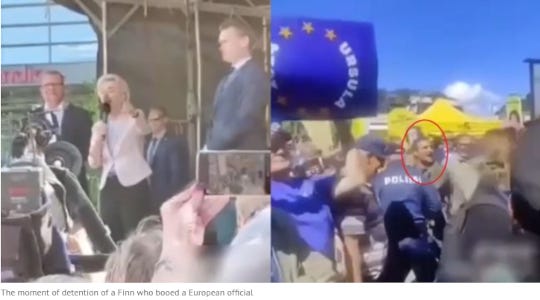
Armando Mema's right to freedom of speech, including the right to question EU leaders who allegedly represent him, is not "protected." Rather, that right is "restricted" in Finland and everywhere else in the EU. Armando Mema is one of approximately 450 million EU citizens who don't have any protected right to freedom of speech precisely because the EU declares itself a "representative democracy." If the Putin regime that von der Leyen cited is a political dictatorship, then it appears the EU is indivisible from it. The EMFA exemplifies that fact.
To say that an independent and pluralistic media—and therefore freedom of speech and expression—can be maintained through government regulation is an oxymoron. By definition, the media cannot be "independent" of the political state if the state regulates the media. Not only that, but, in addition, EMFA regulations couldn't be more draconian.
The EMFA establishes a regulatory European Board for Media Services (the Board) to "protect users from harmful content, including disinformation and foreign information manipulation and interference." It is "the Board" that will define what constitutes disinformation or "information manipulation," whatever that is. Undoubtedly, reporting what happened to Armando Mema and even reporting his criticisms of Ursula von der Leyen will be deemed "disinformation" or "manipulated information" and will be censored by the EU's media freedom Board.
The EU isn't alone. All so-called Western democracies are pursuing the same agenda simultaneously. EMFA is more or less a facsimile of the UK Online Safety Act (OSA) and of the Kids Online Safety Act (KOSA) proposed and currently under debate in the US. In a similar vein to the OSA and KOSA, in accordance with EMFA Article 4, "independent" journalism and "media freedom" is protected from state interference unless the state wants to interfere.
Rather like Article 29 of the UN's Universal Declaration of Human Rights—which determines that you don't have any "human rights" if the UN or its member states decide otherwise—Article 4(4)(c) of the EMFA stipulates that governments can take measures against journalists only "on a case-by-case basis by an overriding reason of public interest." That is, whenever the political state chooses. Pursuant to Article 4(4)(d), when state censorship is supposedly necessary in "duly justified exceptional and urgent cases," the state can not only censor journalists' report but also hunt down journalists and punish them and their editors.
Remember, this is called the "Media Freedom" Act. So what does the EMFA empower RD governments to do if they claim they have to act in the "public interest"?
Under Article 4(5), they can "deploy intrusive surveillance software" and any range of intelligence tools to spy on journalists. EU governments, under direction of "the Board," can compel journalists to divulge their sources and confidential information; they can "detain, sanction, [and] intercept" media outlets, editorial boards and journalists or indeed "any person" from whom the state wants to extract information. If an EU state wishes to silence journalists and media outlets, the EMFA grants that state the power to "seize" the premises and equipment—such as laptops or printing presses—of any media organisation or journalist the state doesn't like.
The EMFA is an EU censorship and information control Enabling Act. The concepts of freedom or rights of any kind—let alone democratic rights or values—are well and truly discarded by EMFA.
This kind of dictatorial legislation is pretty normal for RDs. Representative politicians like von der Leyen extol "democratic ideals" only as propaganda devices. In truth, representative politicians—especially the most successful, as von der Leyen clearly is—despise democratic ideals and never miss an opportunity to ignore them.
So, why do people still imagine they live in "democracies," when in fact the evidence points to them living in dictatorships?
Representative Democracy
In RD systems, people infrequently vote to devolve their individual sovereignty to other people. They agree to obey the diktats of their "representatives" until the next "election." Then, when that election rolls around, they reaffirm their obedience to the magical beings. And for their entire term of office, the magical beings will continue to ignore all of their constituents' alleged democratic rights. Most people who live in an RD system will exercise their "democratic right” to vote on no more than 30 days across their entire lifespan.
In an RD system, the "government" is permanent. It centralises all political power. Oligarchs can easily convert their wealth to political power by corrupting a tiny cadre of useful idiots.
RDs are nothing more than functional oligarchies. The representative politician's only real role in such a system is to implement the policies handed to him by oligarchs and their policy think tanks. No wonder our representatives want us to believe that RD is democracy. Thus deluded, we remain convinced that we have democratically enshrined rights and are consequently willing to accept any oppression and fabrication—including the lie that we are protecting our blessed RD against evil bogeymen like Putin.
Representative democracy is not democracy! Representative democracy empowers functional oligarchies, period. In an actual democracy, there would be no permanent group of lawmakers to be corrupted by oligarchs. Simply put, oligarchy could not possibly function in a democracy.
Democracy
In a real democracy, there is no mechanism by which rights are granted, upheld, or revoked. Everyone is born with individual, inalienable rights, and everyone has the same equal rights. No one can justly transgress anyone's inalienable rights absent the lawful application of the science of justice.
If a country really were a democracy—and there currently are none—it wouldn't have any politicians. The people would govern themselves through the observance and enforcement of the "Rule of Law." They would do this through jury-led trials, where juries are formed by a random selection of the people—called "sortition."
Real democracy demands that people are permanently engaged in the democratic process. They must be skilled in critical thinking and well-versed in the "science of justice"—Natural Law. They must be ready, at any moment, to put their skills and knowledge into practice.
In a democracy, there would be a body to propose laws. In a democracy, there would also be another, perhaps larger body, that would enact laws. But, just like the juries sitting in courts across the land, they too would be formed by a random sortition of the people.
In a democracy, people—selected randomly from the population—would temporarily serve in the law-making body. A different group of randomly selected people would temporarily serve in the law-passing body. Like jurors, once their service was complete, they would disband and return to their normal lives.
In a democracy, the Rule of Law would be based upon the peoples' comprehension and application of Natural Law: their appreciation of the science of justice. The objective of the jury would be to establish the "guilt" of the accused and, most importantly, to restore justice where necessary.
In a democracy, guilt is proven only if the jury is unanimously convinced by the evidence that the accused acted with mens rea, or a "guilty mind." This means that the accused knew their actions would cause real material harm or loss to another person, thereby violating that person's inalienable rights. When a jury is familiar with the science of justice, merely breaking a written "law" is not enough for the jury to find someone "guilty."
Should the jury accept that the accused broke some written law (legislation) but was not guilty of causing (or of intending to cause) any material harm or loss, then the jury would find the law, not the accused, at fault. They would regard the faulty law as being in need of rescission or amendment. In a democracy, any jury of the people could therefore "annul"—meaning declare void or invalid—any law they found to be unjust. The process is called "nullification."
In such circumstances, a new group of randomly selected people would have to reconsider the annulled law. They would perhaps amend it accordingly and send it back to the separate but new group of randomly selected people who might consider enacting an amended form of the previously annulled law. This new law would then be put to the justice test in jury-led courts entirely controlled by random selections of the people.
In a democracy, the Rule of Law would be the rule of the people. Laws would be formed and established by the people, for the people. Crucially, in a democracy, the people would not simply obey laws through fear of punishment but rather would obey laws because the laws are just. If individuals choose not to obey the agreed-upon laws, they would be subject to trial by a jury of their peers, who would determine their possible guilt and decide their punishment in order to restore justice.
The sociopolitical system described as "democracy" has nothing to do with electing representatives.
"Representative democracy" will never be "democracy."
Trolls and bots are not welcome!
********************************
This a Substack comment thread freely open to all. It is intended to provide a space for productive dialogue.
Everyone is free to comment. Please be civil and courteous to each other. Have a laugh, use irony, whit, sarcasm, whatever you like. Argue your point, show your evidence. But please do not be personal, abusive, or accusatory just because someone disagrees with or questions you.
Personal abuse will result in one warning. If abuse persists, after the warning, the abusive account will be blocked and permanently barred from commenting on my Substack posts.
Please, only reply to this message if you wish to alert me to abusive behaviour.
Thank you.
Another excellent piece Iain. I only started "awakening" around Brexit but these last 5 years have felt increasingly impotent and despondent about my kids futures as I understood more about our Matrix. I will always be contrary though!